Culture, Economy and Community as Foundations of Material Circularity
12:30–13:30
Lunch
Lunch
13:30–15:00
Making Session: Adding sediments of thoughts and memories to the Alluvial Archive
—
15:00–16:00
Archipelagos of Learning and Sharing
—
16:00以降From 16:00
Untying and unwinding with remarks and thank you over light catering
—
10:00–11:00 · NEXT250
Provocation — フィールドワーク共有へのフィードバックProvocation — feedback on fieldwork sharing
Prof. Chương/参加者からの応答Responses from Prof. Chương and participants
独立した講義ではなく、共有への応答A response to shared experiences, not a standalone lecture
山田の訂正に従い、Prof. Chươngの発言は参加者のフィールドワーク共有に対するフィードバック/コメントとして扱う。水を生活の外にある対象としてではなく、身体を含む日々の暮らしを取り囲む存在として捉える視点が語られた。Following Suika’s correction, Prof. Chương’s remarks are treated as feedback on participants’ fieldwork sharing. Water was considered not as an external object but as something surrounding daily life, including the body.
家庭の経験から、流域のガバナンスへFrom family experience to basin governance
家庭、洪水、開発、経済格差をめぐる論点から、国境を越える水資源のガバナンスへ議論が広がった。メコンの持続可能な利用をめぐる国際的な合意、ライン川との比較、カンボジアとTonle Sap、ASEANへの言及を通して、水を分断ではなく人々を結びつける共通の課題として考えた。子どもに関する話は、訪問先の家庭ではなくProf. Chương自身の子どものことだという訂正を保持する。The discussion moved from family, flooding, development and inequality to cross-border water governance. International agreements on sustainable Mekong use, comparison with the Rhine, Cambodia, Tonle Sap and ASEAN framed water as a shared concern that brings people together rather than divides them. The child mentioned was Prof. Chương’s own, not a child from a visited household.
水を共有することと、精神的な関係Sharing water and spiritual relationships
デルタに根ざしたhomegrown / engaged Buddhismは、戦争や植民地化の経験に応答し、人々を支える精神的な力として語られた。eco-Buddhismや川のspiritual elementにも言及があった。自然との調和、ココナッツの木をnothing goes to wasteとする利用のあり方、今後の運河と仏教拠点をたどる構想が記録されている。国境地域のサイバー犯罪・人身取引への言及もあるが、個別事例は未取得。Homegrown and engaged Buddhism rooted in the delta was discussed as a source of strength responding to war and colonialism. Eco-Buddhism and the river’s spiritual element were also mentioned. Notes record harmony with nature, coconut use in which “nothing goes to waste,” and ideas for future canal and Buddhist-centre routes. Border-region cybercrime and trafficking were mentioned, but specific cases were not retrieved.
Oxfamの映像紹介と応答Oxfam film introduction and responses
続く応答では、OxfamのMekong Delta climate change resilience projectが紹介された。水に育まれながら水に脅かされる暮らし、poverty、livelihood、climate changeが話題となった。ベトナム語の文字起こしは大きく崩れているとの記録があるため、家屋や波への対策の具体的方法は特定していない。A subsequent response introduced Oxfam’s Mekong Delta climate change resilience project. Discussion addressed lives both nourished and threatened by water, poverty, livelihoods and climate change. The Vietnamese transcript was reportedly badly garbled, so specific housing or wave-protection measures are not identified.
話者の区切りSpeaker boundaries
「次の登壇者」以降をProf. Chươngのフィードバック/クロージングとして記録するという訂正も保持する。全文を回収できていないため、個々の断片を映像紹介者など別の話者に再配分してはいない。The correction assigning the portion after “the next speaker” to Prof. Chương’s feedback or closing is retained. Without the complete transcript, fragments have not been reassigned to the film presenter or other speakers.
水の世界に身体ごと入るEntering the water world with the whole body
District 7からVinFastで到着した場面、仲間との時間が終わる寂しさ、船底を通して感じる波紋や風が語られた。水の世界に身体ごと入り、小さな痕跡を拾ってつながりやパターンを見いだすという応答である。これはDay 3の訪問先の発言ではなく、Prof. Chươngのフィードバックに位置づける。Remarks recalled arriving from District 7 in a VinFast, sadness at time with companions ending, and ripples and wind felt through the boat’s bottom. Entering the water world bodily and assembling small traces into connections and patterns formed part of Prof. Chương’s feedback, not a Day 3 host’s talk.
文字起こし原文 — 未取得Original transcript — not retrieved
このセッションの文字起こし全文は今回の履歴検索では取得できていません。原文を補作せず、上の本文は取得できた整理記録に基づいています。The complete session transcript was not retrieved through the history search. The text above draws on available edited notes; missing original wording has not been invented.
取得できた整理記録を開くOpen retrieved notes
編集済みの整理文です。文字起こし原文ではありません。Edited notes, not an original transcript.
English companion notes for this section (edited, not a verbatim transcript):

Provocation — feedback on fieldwork sharing

Responses from Prof. Chương and participants

A response to shared experiences, not a standalone lecture

Following Suika’s correction, Prof. Chương’s remarks are treated as feedback on participants’ fieldwork sharing. Water was considered not as an external object but as something surrounding daily life, including the body.

From family experience to basin governance

The discussion moved from family, flooding, development and inequality to cross-border water governance. International agreements on sustainable Mekong use, comparison with the Rhine, Cambodia, Tonle Sap and ASEAN framed water as a shared concern that brings people together rather than divides them. The child mentioned was Prof. Chương’s own, not a child from a visited household.

Sharing water and spiritual relationships

Homegrown and engaged Buddhism rooted in the delta was discussed as a source of strength responding to war and colonialism. Eco-Buddhism and the river’s spiritual element were also mentioned. Notes record harmony with nature, coconut use in which “nothing goes to waste,” and ideas for future canal and Buddhist-centre routes. Border-region cybercrime and trafficking were mentioned, but specific cases were not retrieved.

Oxfam film introduction and responses

A subsequent response introduced Oxfam’s Mekong Delta climate change resilience project. Discussion addressed lives both nourished and threatened by water, poverty, livelihoods and climate change. The Vietnamese transcript was reportedly badly garbled, so specific housing or wave-protection measures are not identified.

Speaker boundaries

The correction assigning the portion after “the next speaker” to Prof. Chương’s feedback or closing is retained. Without the complete transcript, fragments have not been reassigned to the film presenter or other speakers.

Entering the water world with the whole body

Remarks recalled arriving from District 7 in a VinFast, sadness at time with companions ending, and ripples and wind felt through the boat’s bottom. Entering the water world bodily and assembling small traces into connections and patterns formed part of Prof. Chương’s feedback, not a Day 3 host’s talk.

Key points

Bodily field experiences opened questions about family, livelihoods, inequality, cross-border water sharing and spirituality. Read this as a response to participants’ sharing rather than a lecture.

Copy
11:00–12:30 · Round 3 / Track 1 · NEXT250
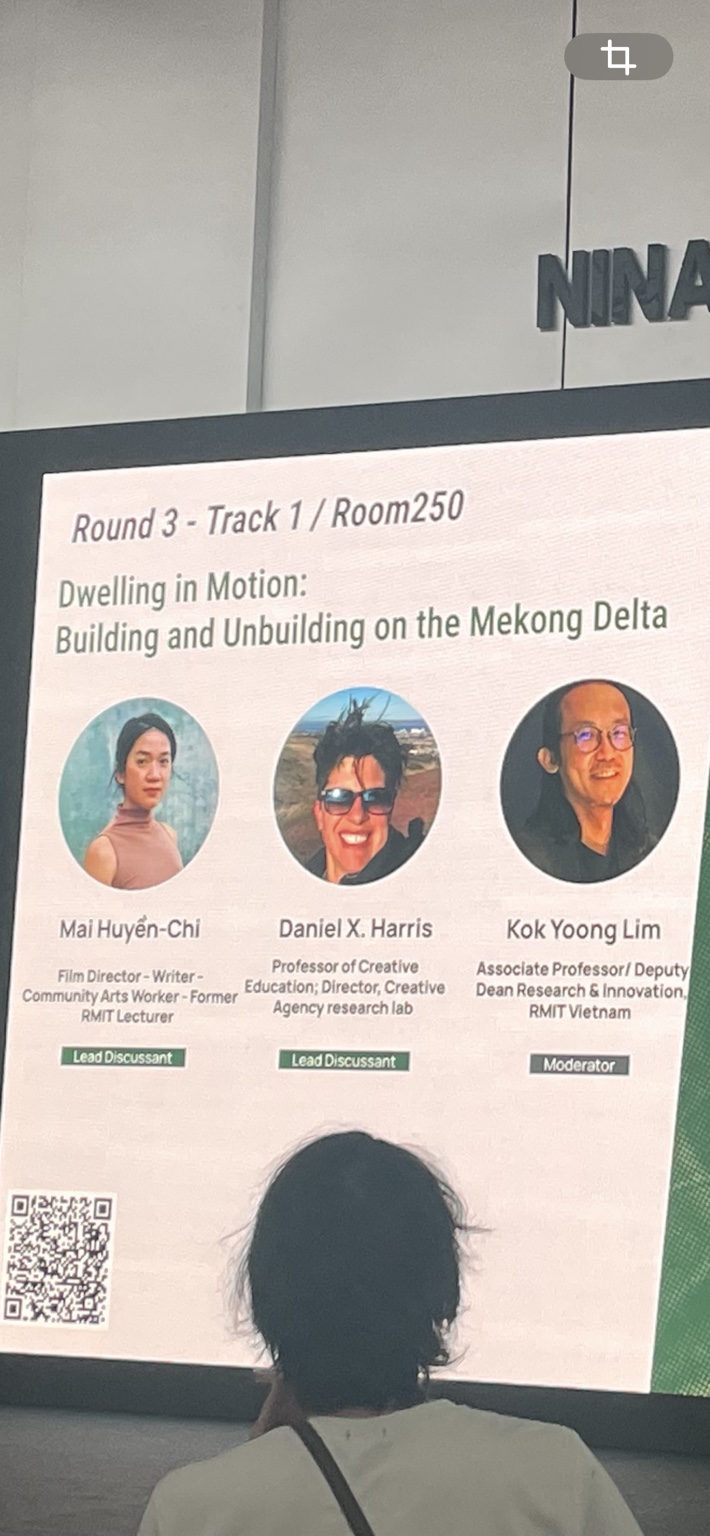
Dwelling in Motion: Building and Unbuilding on the Mekong Delta
Lead Discussants:Mai Huyền-Chi / Daniel X. Harris Moderator:Kok Yoong Lim
Dwelling in Motionの登壇者スライド。Day 5・Round 3・Track 1。Dwelling in Motion speaker slide. Day 5, Round 3, Track 1.
移動・記憶・homeをめぐる詩と映像Poetry and film on migration, memory and home
Daniel X. Harrisの発表は、adoptee、migrant、queer / transという自らの立ち位置から、migration、memory、home、river、adaptabilityを扱ったと整理されている。「Here, like there.」という表現を含み、記憶を流動するもの、homeをつくり直し続けるものとして扱う。The notes describe Daniel X. Harris approaching migration, memory, home, rivers and adaptability from their position as an adoptee, migrant and queer/trans person. “Here, like there” appears in an account of fluid memory and home as something continually remade.
身体の経験を知識として扱うBodily experience as knowledge
creative practice、autoethnography、participatory research、embodied experienceを通して、身体的な経験を知識として扱うアプローチが記録されている。homeは動かない一つの場所だけでなく、移動と記憶の中でmake / remakeされるLiving Memoryとして整理された。Creative practice, autoethnography, participatory research and embodied experience were approaches to bodily knowledge. Home was understood as Living Memory made and remade through movement and recollection, not solely one fixed place.
Community filmmaking — 撮らずに共にいることCommunity filmmaking — being together without filming
議論では、community filmmakingそのものが外部者による介入であるという認識が共有された。撮影しないで共にいること、参加者が制作を決めるagency、技術的なqualityよりも関係性と倫理を重視することが論点となった。The discussion recognised community filmmaking itself as an outsider’s intervention. Themes included being together without filming, participants’ agency to decide whether to make a work, and prioritising relationships and ethics over technical quality.
話者への帰属と聞き取りの限界Attribution and listening limits
Mai Huyền-ChiとDaniel X. Harrisの登壇は写真で確認できる。一方、今回取得できた後半の整理では、発言ごとの話者が明確でないため、community filmmakingの議論はセッション全体の記録として掲載した。後半の文字起こしは音声認識が大きく崩れているとの記録があり、不明箇所を流暢な発言へ補作していない。Photographs confirm Mai Huyền-Chi and Daniel X. Harris as speakers. Individual voices in the later notes are unclear, so the community-filmmaking discussion is recorded at session level. Speech recognition was reportedly badly garbled; unclear passages have not been rewritten as fluent quotations.
Mai Huyền-Chi — 川辺の子ども、匿名性、家族の記憶Mai Huyền-Chi — riverside children, anonymity and family memory
2019年のラオスや中国上流域のダムへの関心から、川辺の子どもたちとの関わり、撮影対象の匿名性へと問いが広がった。戦争、国家、移住、喪失に関わる家族史と、土地・湿地・コミュニティとの長期的な協働が重なる。映像の制作を一度きりの採取にせず、誰が語り、誰が見られるのかという関係を扱う。作品名は未確認のため特定しない。An interest in upstream dams in Laos and China in 2019 led into relationships with riverside children and the anonymity of those filmed. Family histories of war, the state, migration and loss intersect with long-term collaboration with land, wetlands and communities. Filmmaking addresses who speaks and who is seen, rather than extracting material in one visit. Film titles are unconfirmed and not specified.
文字起こし原文 — 未取得Original transcript — not retrieved
このセッションの文字起こし全文は今回の履歴検索では取得できていません。原文を補作せず、上の本文は取得できた整理記録に基づいています。The complete session transcript was not retrieved through the history search. The text above draws on available edited notes; missing original wording has not been invented.
取得できた整理記録を開くOpen retrieved notes
編集済みの整理文です。文字起こし原文ではありません。Edited notes, not an original transcript.
移動・記憶・homeをめぐる詩と映像

Daniel X. Harrisの発表は、adoptee、migrant、queer / transという自らの立ち位置から、migration、memory、home、river、adaptabilityを扱ったと整理されている。「Here, like there.」という表現を含み、記憶を流動するもの、homeをつくり直し続けるものとして扱う。

身体の経験を知識として扱う

creative practice、autoethnography、participatory research、embodied experienceを通して、身体的な経験を知識として扱うアプローチが記録されている。homeは動かない一つの場所だけでなく、移動と記憶の中でmake / remakeされるLiving Memoryとして整理された。

Community filmmaking — 撮らずに共にいること

議論では、community filmmakingそのものが外部者による介入であるという認識が共有された。撮影しないで共にいること、参加者が制作を決めるagency、技術的なqualityよりも関係性と倫理を重視することが論点となった。

話者への帰属と聞き取りの限界

Mai Huyền-ChiとDaniel X. Harrisの登壇は写真で確認できる。一方、今回取得できた後半の整理では、発言ごとの話者が明確でないため、community filmmakingの議論はセッション全体の記録として掲載した。後半の文字起こしは音声認識が大きく崩れているとの記録があり、不明箇所を流暢な発言へ補作していない。

Mai Huyền-Chi — 川辺の子ども、匿名性、家族の記憶2019年のラオスや中国上流域のダムへの関心から、川辺の子どもたちとの関わり、撮影対象の匿名性へと問いが広がった。戦争、国家、移住、喪失に関わる家族史と、土地・湿地・コミュニティとの長期的な協働が重なる。映像の制作を一度きりの採取にせず、誰が語り、誰が見られるのかという関係を扱う。作品名は未確認のため特定しない。
English companion notes for this section (edited, not a verbatim transcript):

Dwelling in Motion speaker slide. Day 5, Round 3, Track 1.

Poetry and film on migration, memory and home

The notes describe Daniel X. Harris approaching migration, memory, home, rivers and adaptability from their position as an adoptee, migrant and queer/trans person. “Here, like there” appears in an account of fluid memory and home as something continually remade.

Bodily experience as knowledge

Creative practice, autoethnography, participatory research and embodied experience were approaches to bodily knowledge. Home was understood as Living Memory made and remade through movement and recollection, not solely one fixed place.

Community filmmaking — being together without filming

The discussion recognised community filmmaking itself as an outsider’s intervention. Themes included being together without filming, participants’ agency to decide whether to make a work, and prioritising relationships and ethics over technical quality.

Attribution and listening limits

Photographs confirm Mai Huyền-Chi and Daniel X. Harris as speakers. Individual voices in the later notes are unclear, so the community-filmmaking discussion is recorded at session level. Speech recognition was reportedly badly garbled; unclear passages have not been rewritten as fluent quotations.

Mai Huyền-Chi — riverside children, anonymity and family memory

An interest in upstream dams in Laos and China in 2019 led into relationships with riverside children and the anonymity of those filmed. Family histories of war, the state, migration and loss intersect with long-term collaboration with land, wetlands and communities. Filmmaking addresses who speaks and who is seen, rather than extracting material in one visit. Film titles are unconfirmed and not specified.

Key points

Dwelling was considered as something remade through movement, memory and relationships. Filmmaking raised questions of being together, participants’ agency and the ethics of intervention alongside the work itself.

Copy
11:00–12:30 · Round 3 / Track 2 · NEXT100
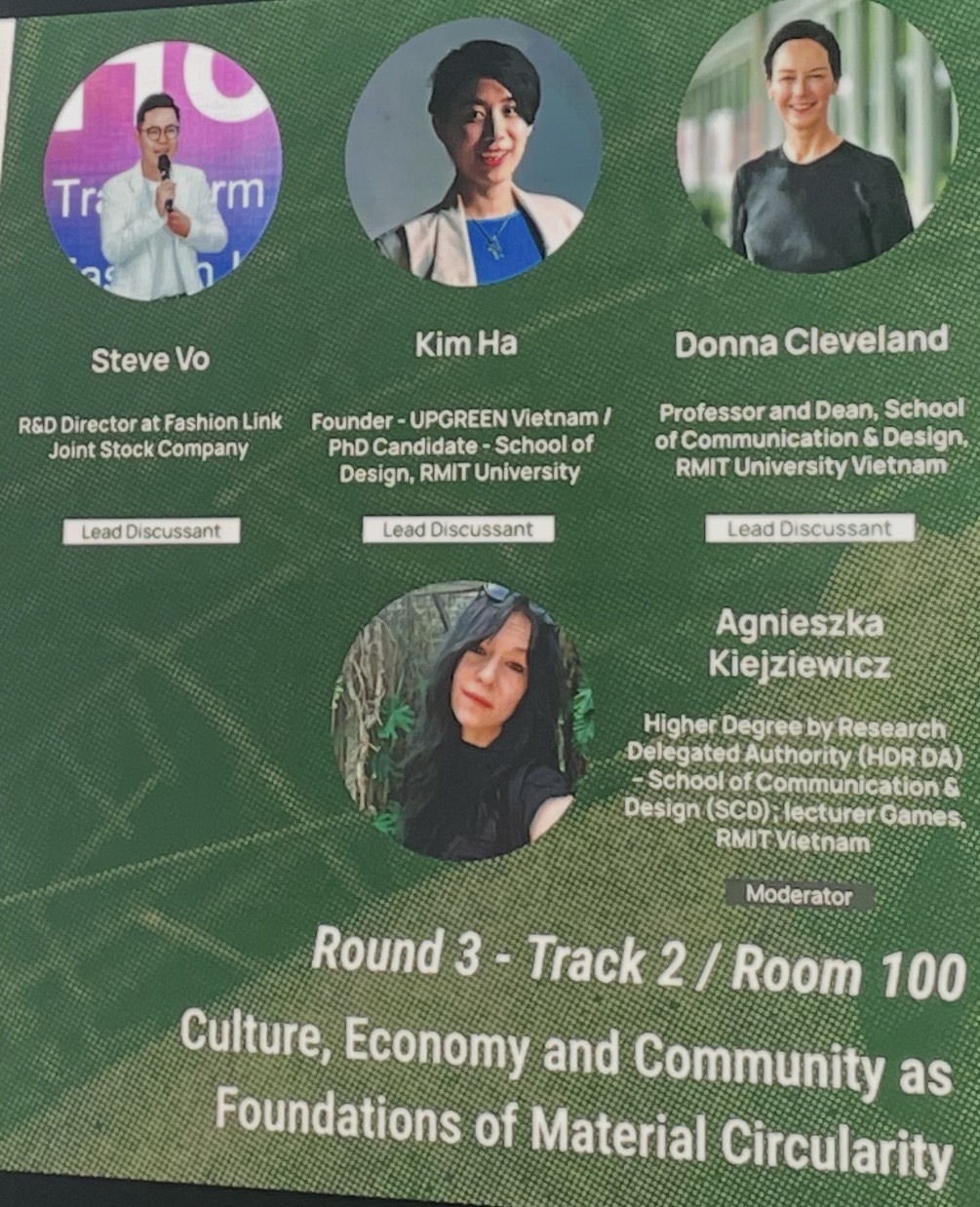
Culture, Economy and Community as Foundations of Material Circularity
Leads:Steve Vo / Kim Ha / Donna Cleveland | Moderator:Agnieszka Kiejziewicz
Day 5・Track 2の登壇者案内。画像内のFashion Link表記は、本文では訂正後のFaslinkに統一。Day 5 Track 2 speaker announcement. The image says Fashion Link; the text uses the corrected name Faslink.
パイナップル葉の農業副産物を繊維へつなぐPINALINA™(Pinalina)が紹介された。名称は山田訂正に合わせ、Faslink、Steve Voを採用する。化学薬品を使わない繊維処理という説明、綿80%・パイナップル繊維20%のサンプル、消臭・UV対策、農家収入やCO₂に関わる利点が語られた。これらはセッション内の説明であり、この記録で性能を検証したものではない。PINALINA™ (Pinalina), made from agricultural pineapple-leaf byproducts, was introduced. Faslink and Steve Vo follow Suika’s corrections. The session described chemical-free fibre processing, an 80% cotton/20% pineapple sample, odour control, UV protection and benefits concerning farmer income and CO₂. These are session claims, not performance independently verified here.
Anh “Dứa” Em “Thơm”
コレクションを通して、ファッションとベトナムの農業・市場を接続する試みが紹介された。素材の置き換えにとどまらず、農業副産物が価値を持ち、つくり手と使い手の関係が続く仕組みが論点となる。The collection connected fashion with Vietnamese agriculture and markets. Beyond replacing a material, the discussion concerned ways agricultural byproducts acquire value and relationships between makers and users can continue.
UPGREEN — 再生プラスチックと漆UPGREEN — recycled plastic and lacquer
再生プラスチックにベトナムの漆を5〜6層重ねる実践と、NFCでインパクト情報を伝える仕組みが紹介された。回収者 → 加工者 → スタジオ → 顧客というつながりを閉じた循環へ近づける試みとして扱われた。The presentation described applying five or six layers of Vietnamese lacquer to recycled plastic and communicating impact information through NFC. It sought to close loops linking collectors, processors, the studio and customers.
循環を成立させる文化・経済・コミュニティCulture, economy and community supporting circularity
素材の循環には、担い手の関係、収入、地域の文化、行政との関わりが必要となる。資本主義や物々交換をめぐる議論もあったが、一つの制度や解決策へ決着したとは記録されていない。Material circulation depends on relationships, income, local culture and government involvement. Capitalism and barter were discussed, but the records do not establish agreement on a single system or solution.
文字起こし原文 — 未取得Original transcript — not retrieved
音声の文字起こし全文は回収できていません。本文は取得できた整理記録に基づき、原文を補作していません。The full audio transcript has not been recovered. The text is based on available edited notes; missing original wording has not been invented.
編集済み整理記録を開くOpen edited notes
文字起こし原文ではありません。取得できた記録を統合した整理文です。These are consolidated edited notes from the retrieved records, not a verbatim transcript.
English companion notes for this section (edited, not a verbatim transcript):

Day 5 Track 2 speaker announcement. The image says Fashion Link; the text uses the corrected name Faslink.

Faslink / PINALINA™ — connecting agriculture and clothing

PINALINA™ (Pinalina), made from agricultural pineapple-leaf byproducts, was introduced. Faslink and Steve Vo follow Suika’s corrections. The session described chemical-free fibre processing, an 80% cotton/20% pineapple sample, odour control, UV protection and benefits concerning farmer income and CO₂. These are session claims, not performance independently verified here.

The collection connected fashion with Vietnamese agriculture and markets. Beyond replacing a material, the discussion concerned ways agricultural byproducts acquire value and relationships between makers and users can continue.

UPGREEN — recycled plastic and lacquer

The presentation described applying five or six layers of Vietnamese lacquer to recycled plastic and communicating impact information through NFC. It sought to close loops linking collectors, processors, the studio and customers.

Culture, economy and community supporting circularity

Material circulation depends on relationships, income, local culture and government involvement. Capitalism and barter were discussed, but the records do not establish agreement on a single system or solution.

Key points

Material circularity requires more than reuse technology. The session asked how culture and economics can connect those working in farming, craft, collection, manufacturing and consumption.

Copy
13:30–15:00 · NEXT250
Making Session — Alluvial Archiveに思考と記憶を重ねるMaking Session — layering thoughts and memories into the Alluvial Archive
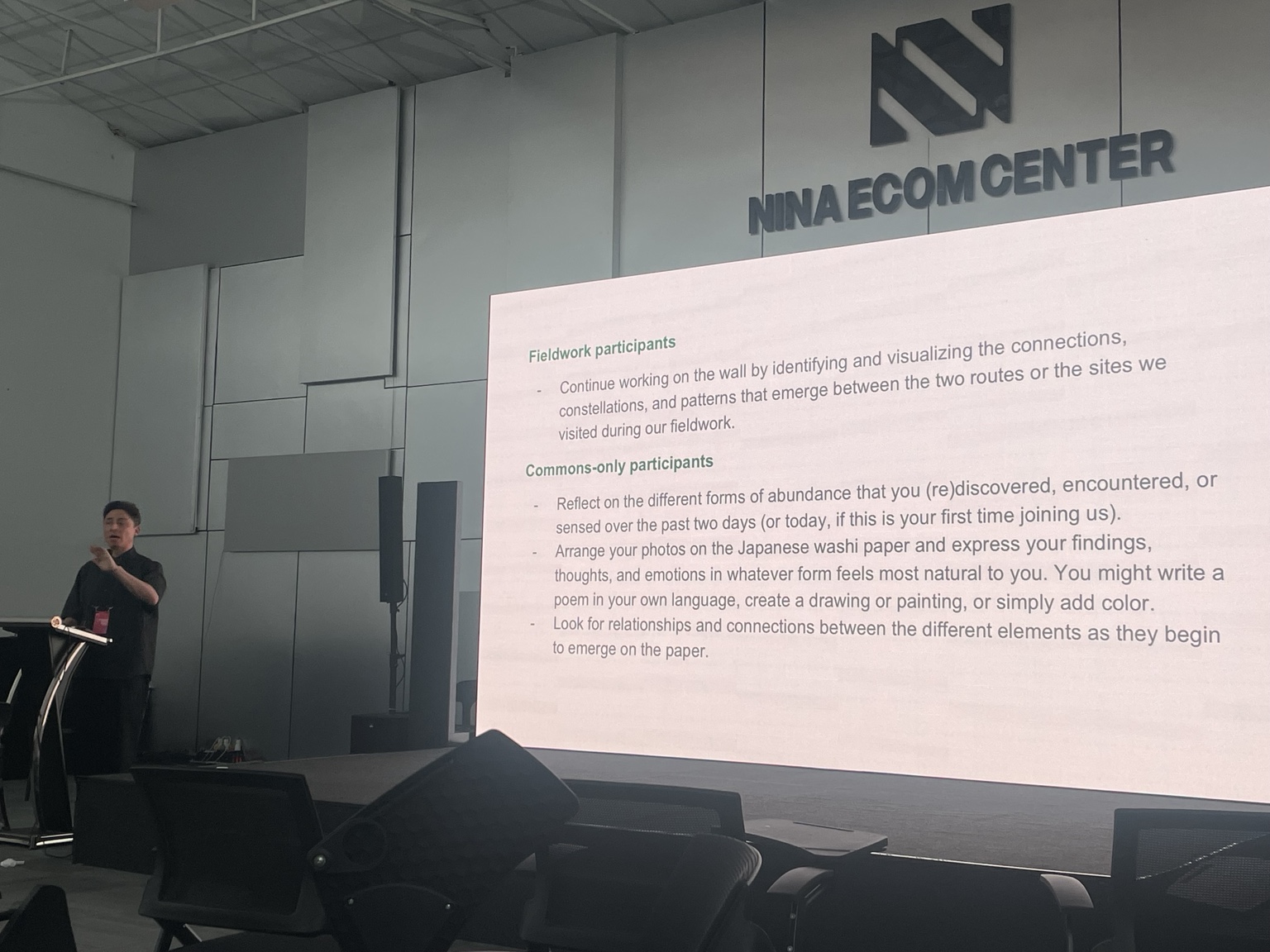
Making Sessionの参加者別ワーク指示。Making Session instructions for each participant group.
異なるルートの間に、つながりを見つけるFinding connections between routes
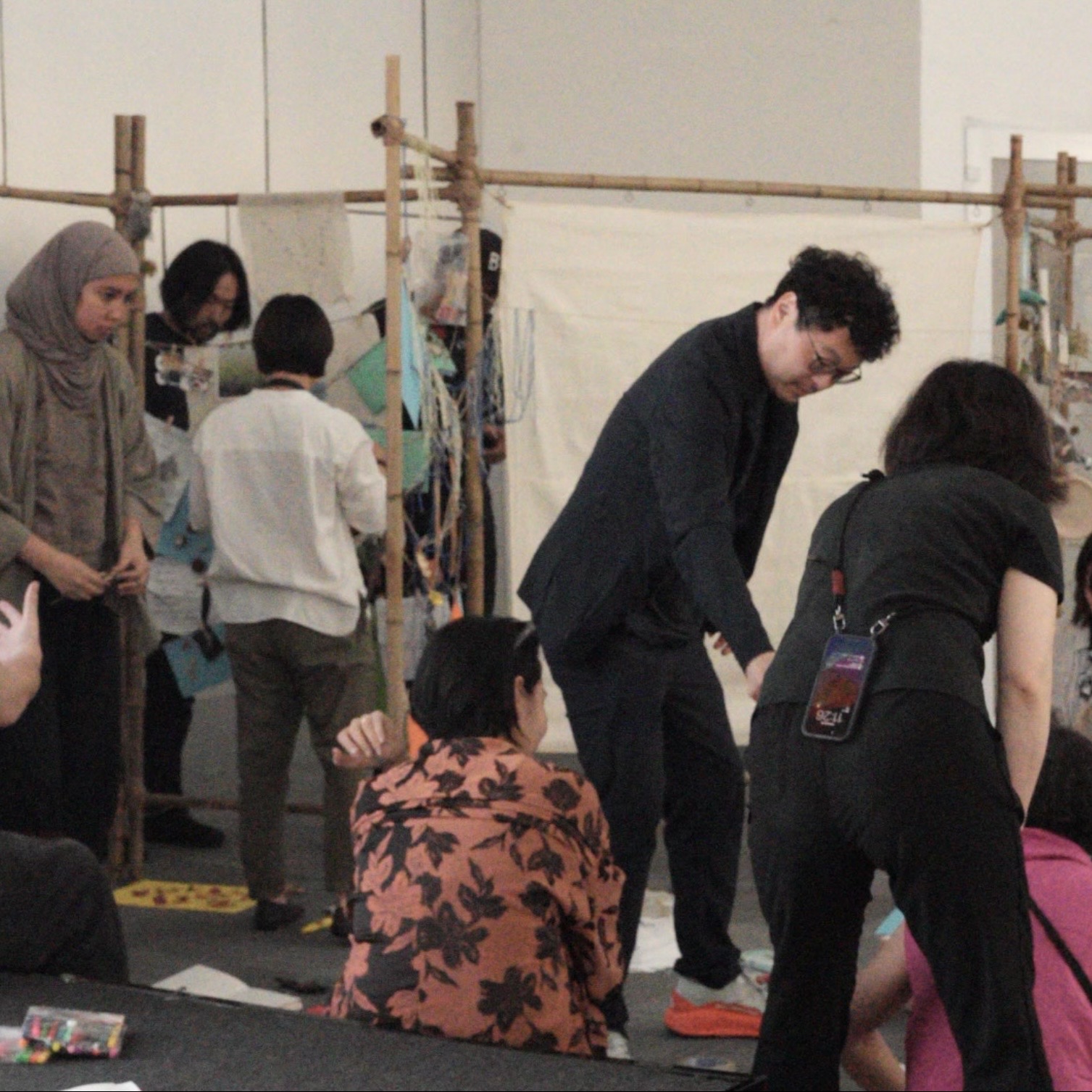
フィールドワーク参加者は、訪れた場所や2つのルートの間に現れるconnections、constellations、patternsを探し、壁に可視化する。Commonsのみの参加者は、過去2日間またはその日に再発見・遭遇・感知した豊かさを振り返り、写真を和紙に配置し、詩・絵・色など自然に感じる形式で表す。要素の間に生まれる関係にも目を向ける。Fieldwork participants identify connections, constellations and patterns between visited places and the two routes, making them visible on the wall. Commons-only participants reflect on abundance rediscovered, encountered or sensed over the previous two days or that day, arranging photos on washi paper and expressing themselves through poetry, drawing or colour. They also attend to emerging relationships between elements.
完成させるより、変化を受け止めるReceiving change rather than only finishing
共有された整理には、Eroding Wall、soft edges、茶色や分解、more-than-humanと地質学的な時間、Exquisite Corpse、カエルをめぐる好奇心が含まれる。作品を固定するだけでなく、崩れたり混ざり合ったりする過程へ視野を開く。The notes include the Eroding Wall, soft edges, brownness and decomposition, more-than-human and geological time, Exquisite Corpse and curiosity about frogs. The emphasis opens towards processes of breaking down and mixing, not only fixing a work in place.
枠組みと、わからなさを残すことReframing and leaving room for not understanding
joss paperをめぐる精神性の複数性と習合、framework自体を捉え直すこと、理解できないものを急いで説明し尽くさずに残すことが論点となった。個々の発言の話者や順序は未確認のため、セッション内の論点として整理する。Discussion addressed plural and syncretic spiritualities around joss paper, reconsidering frameworks themselves, and leaving some things unexplained rather than rushing to account for them. With individual speakers and sequence unconfirmed, these are recorded as session themes.
文字起こし原文 — 未取得Original transcript — not retrieved
音声の文字起こし全文は回収できていません。本文は取得できた整理記録に基づき、原文を補作していません。The full audio transcript has not been recovered. The text is based on available edited notes; missing original wording has not been invented.
編集済み整理記録を開くOpen edited notes
文字起こし原文ではありません。取得できた記録を統合した整理文です。These are consolidated edited notes from the retrieved records, not a verbatim transcript.
English companion notes for this section (edited, not a verbatim transcript):

Making Session — layering thoughts and memories into the Alluvial Archive

Fieldwork participants / Commons-only participants

Making Session instructions for each participant group.

Finding connections between routes

Fieldwork participants identify connections, constellations and patterns between visited places and the two routes, making them visible on the wall. Commons-only participants reflect on abundance rediscovered, encountered or sensed over the previous two days or that day, arranging photos on washi paper and expressing themselves through poetry, drawing or colour. They also attend to emerging relationships between elements.

Receiving change rather than only finishing

The notes include the Eroding Wall, soft edges, brownness and decomposition, more-than-human and geological time, Exquisite Corpse and curiosity about frogs. The emphasis opens towards processes of breaking down and mixing, not only fixing a work in place.

Reframing and leaving room for not understanding

Discussion addressed plural and syncretic spiritualities around joss paper, reconsidering frameworks themselves, and leaving some things unexplained rather than rushing to account for them. With individual speakers and sequence unconfirmed, these are recorded as session themes.

Key points

Photos, memories and words accumulated on washi and the wall, seeking connections across routes and places. Alongside finished work, the session retained openness to change and what cannot be fully understood.

Copy

Copy
スライド記載テキストを開くOpen slide text
提供写真から転記。音声の文字起こしとは区別しています。Transcribed from supplied photographs, distinguished from an audio transcript.
Fieldwork participants
- Continue working on the wall by identifying and visualizing the connections, constellations, and patterns that emerge between the two routes or the sites we visited during our fieldwork.

Commons-only participants
- Reflect on the different forms of abundance that you (re)discovered, encountered, or sensed over the past two days (or today, if this is your first time joining us).
- Arrange your photos on the Japanese washi paper and express your findings, thoughts, and emotions in whatever form feels most natural to you. You might write a poem in your own language, create a drawing or painting, or simply add color.
- Look for relationships and connections between the different elements as they begin to emerge on the paper.
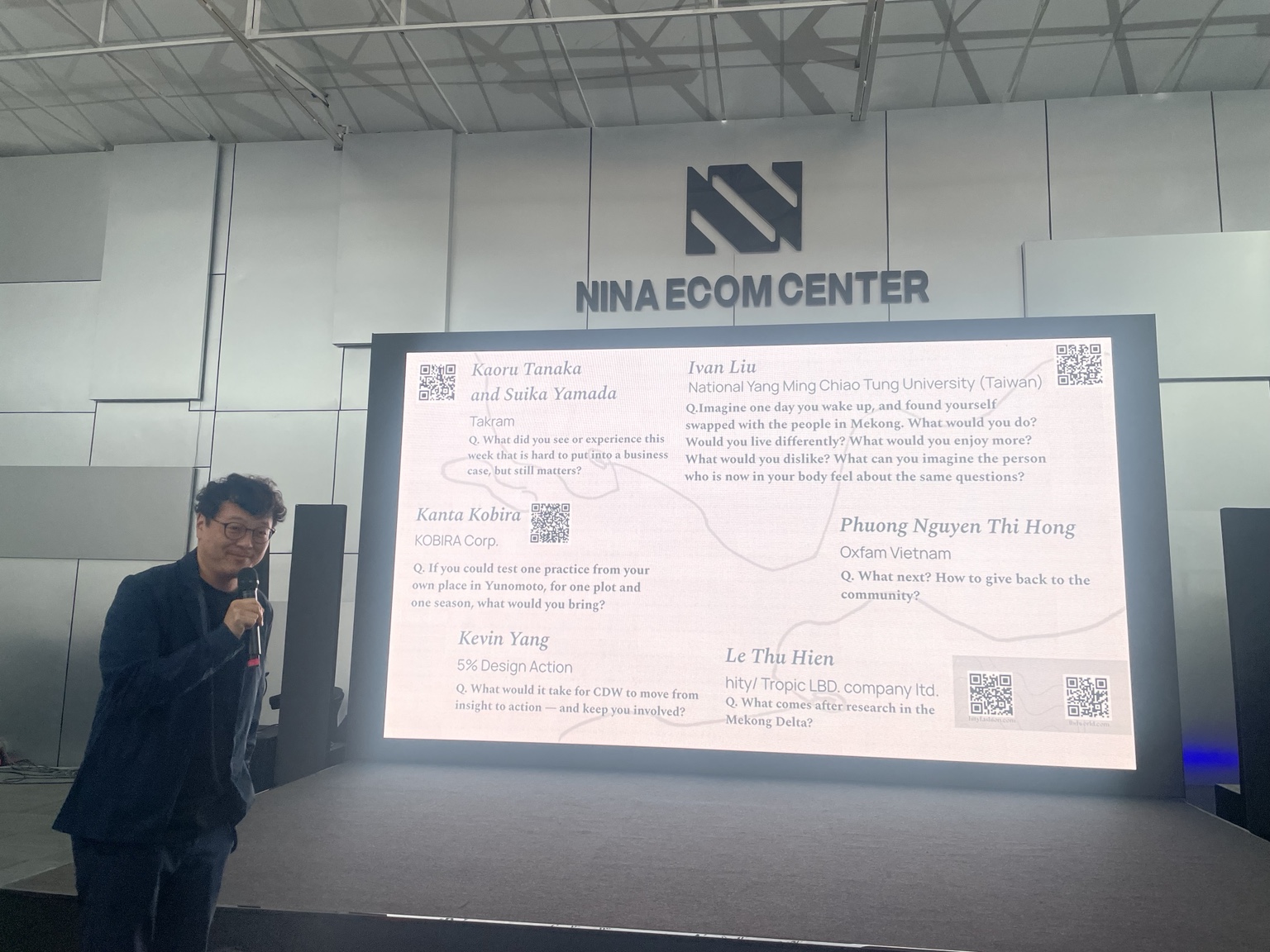
6つの島のホストと問い。Hosts and questions for the six islands.
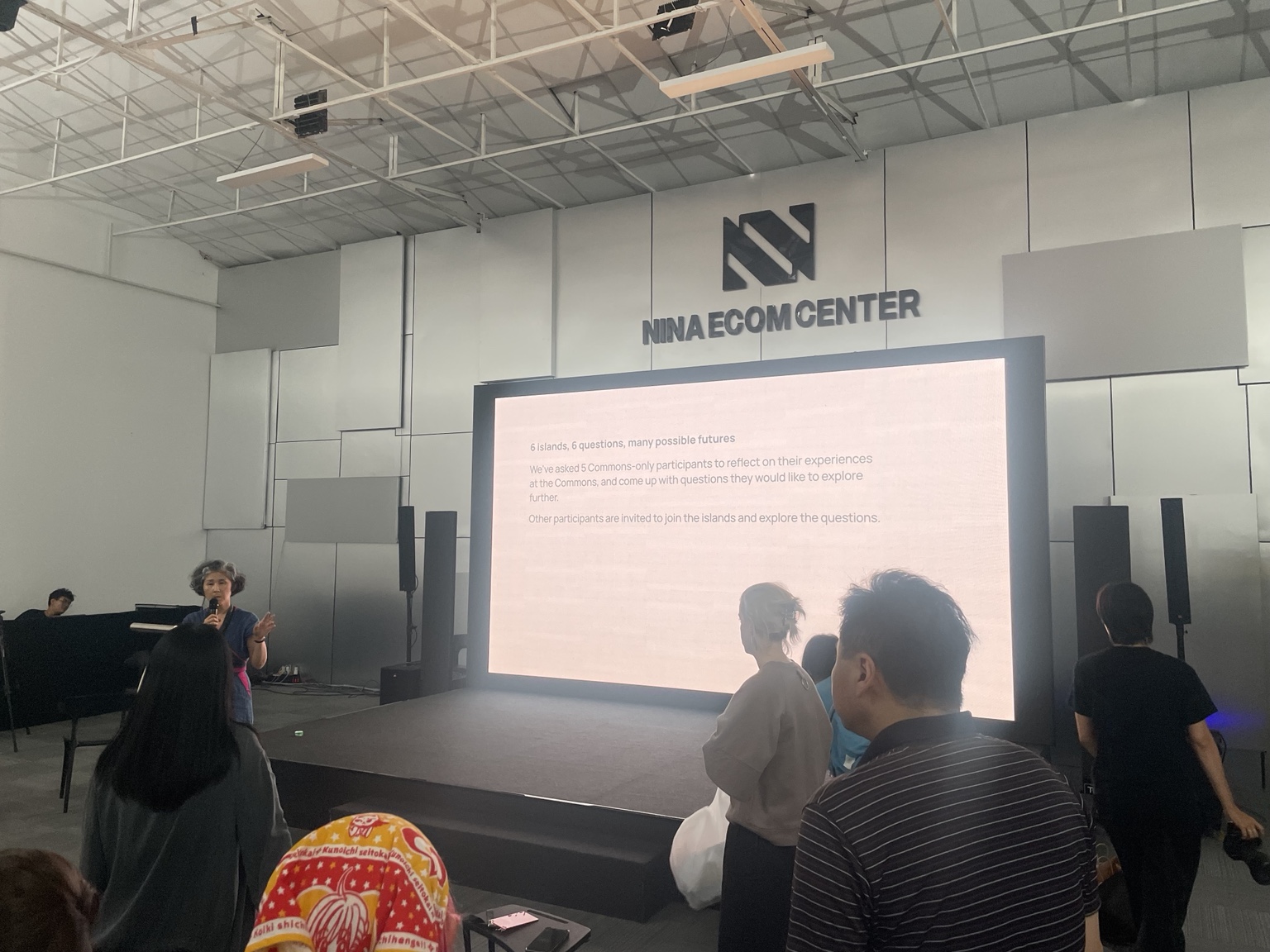
6つの島から次の問いへSix islands leading to further questions
Commonsでの経験をもとに、さらに探りたい問いを掲げた「島」に参加者が加わり、共に考える形式。案内スライドは「Commonsのみの参加者5名に振り返りを依頼」としつつ、6つの島を示している。数の違いは原資料のまま保持する。Participants joined “islands” proposing questions to explore from their Commons experience. The introduction says five Commons-only participants were invited to reflect, while showing six islands. This numerical difference is retained from the source.
Takramの問いTakram’s question
事業として説明しにくくても重要な経験を言葉にする問いが置かれた。他の島には、場所を越えた実践、洞察から行動への移行、暮らしの入れ替わり、地域への還元、調査後の継続をめぐる問いが並ぶ。各グループの議論結果は未取得であり、以下は問いの記録。One question invited articulation of experiences that matter even when difficult to justify as a business case. Other islands addressed practices across places, moving from insight to action, exchanged lives, giving back and continuing after research. Group outcomes were not retrieved; the questions are recorded below.
ホストHost
問い(日本語訳)Question (Japanese translation)
Kaoru Tanaka / Suika Yamada — Takram
今週見たり経験したりしたもので、事業の根拠には落とし込みにくいけれど、大切なものは何か?What did you see or experience this week that is hard to put into a business case, but still matters?
Kanta Kobira — KOBIRA Corp.
自分の土地の実践をYunomotoの一区画・一季節で試すなら、何を持ち込むか?If you could test one practice from your own place in Yunomoto, for one plot and one season, what would you bring?
Kevin Yang — 5% Design Action
CDWが洞察から行動へ進み、あなたが関わり続けるには何が必要か?What would it take for CDW to move from insight to action — and keep you involved?
Ivan Liu — National Yang Ming Chiao Tung University (Taiwan)
メコンの人と身体や暮らしが入れ替わったら何をするか。何を楽しみ、何を好まないか。相手はどう感じるだろうか?If you swapped bodies and lives with someone in the Mekong, what would you do? What would you enjoy or dislike? How might the other person feel?
Phuong Nguyen Thi Hong — Oxfam Vietnam
次は何をするか。コミュニティにどう還元するか?What next? How to give back to the community?
Le Thu Hien — hity / Tropic LBD. company ltd.
メコンデルタでの調査の後には、何が続くのか?What comes after research in the Mekong Delta?
文字起こし原文 — 未取得Original transcript — not retrieved
音声の文字起こし全文は回収できていません。本文は取得できた整理記録に基づき、原文を補作していません。The full audio transcript has not been recovered. The text is based on available edited notes; missing original wording has not been invented.
編集済み整理記録を開くOpen edited notes
文字起こし原文ではありません。取得できた記録を統合した整理文です。These are consolidated edited notes from the retrieved records, not a verbatim transcript.
English companion notes for this section (edited, not a verbatim transcript):

Archipelagos participation instructions.

Hosts and questions for the six islands.

Six islands leading to further questions

Participants joined “islands” proposing questions to explore from their Commons experience. The introduction says five Commons-only participants were invited to reflect, while showing six islands. This numerical difference is retained from the source.

Takram’s question

One question invited articulation of experiences that matter even when difficult to justify as a business case. Other islands addressed practices across places, moving from insight to action, exchanged lives, giving back and continuing after research. Group outcomes were not retrieved; the questions are recorded below.

Host

Question (Japanese translation)

What did you see or experience this week that is hard to put into a business case, but still matters?

If you could test one practice from your own place in Yunomoto, for one plot and one season, what would you bring?

What would it take for CDW to move from insight to action — and keep you involved?

If you swapped bodies and lives with someone in the Mekong, what would you do? What would you enjoy or dislike? How might the other person feel?

What next? How to give back to the community?

What comes after research in the Mekong Delta?

Key points

Fieldwork and Commons experiences led to further questions about business value, exchanging places, sustained action and giving back to communities.

Copy

Copy
スライド記載テキストを開くOpen slide text
提供写真から転記。ホスト名と問いを対応づけています。音声の文字起こしではありません。Transcribed from supplied photographs, matching hosts with questions. This is not an audio transcript.
6 islands, 6 questions, many possible futures

We’ve asked 5 Commons-only participants to reflect on their experiences at the Commons, and come up with questions they would like to explore further.
Other participants are invited to join the islands and explore the questions.

Kaoru Tanaka / Suika Yamada — Takram
What did you see or experience this week that is hard to put into a business case, but still matters?

Kanta Kobira — KOBIRA Corp.
If you could test one practice from your own place in Yunomoto, for one plot and one season, what would you bring?

Kevin Yang — 5% Design Action
What would it take for CDW to move from insight to action — and keep you involved?

Ivan Liu — National Yang Ming Chiao Tung University (Taiwan)
Imagine one day you wake up, and found yourself swapped with the people in Mekong. What would you do? Would you live differently? What would you enjoy more? What would you dislike? What can you imagine the person who is now in your body feel about the same questions?

Phuong Nguyen Thi Hong — Oxfam Vietnam
What next? How to give back to the community?

Le Thu Hien — hity / Tropic LBD. company ltd.
What comes after research in the Mekong Delta?